Architecture Studio Management: Connecting Decisions with Business Metrics
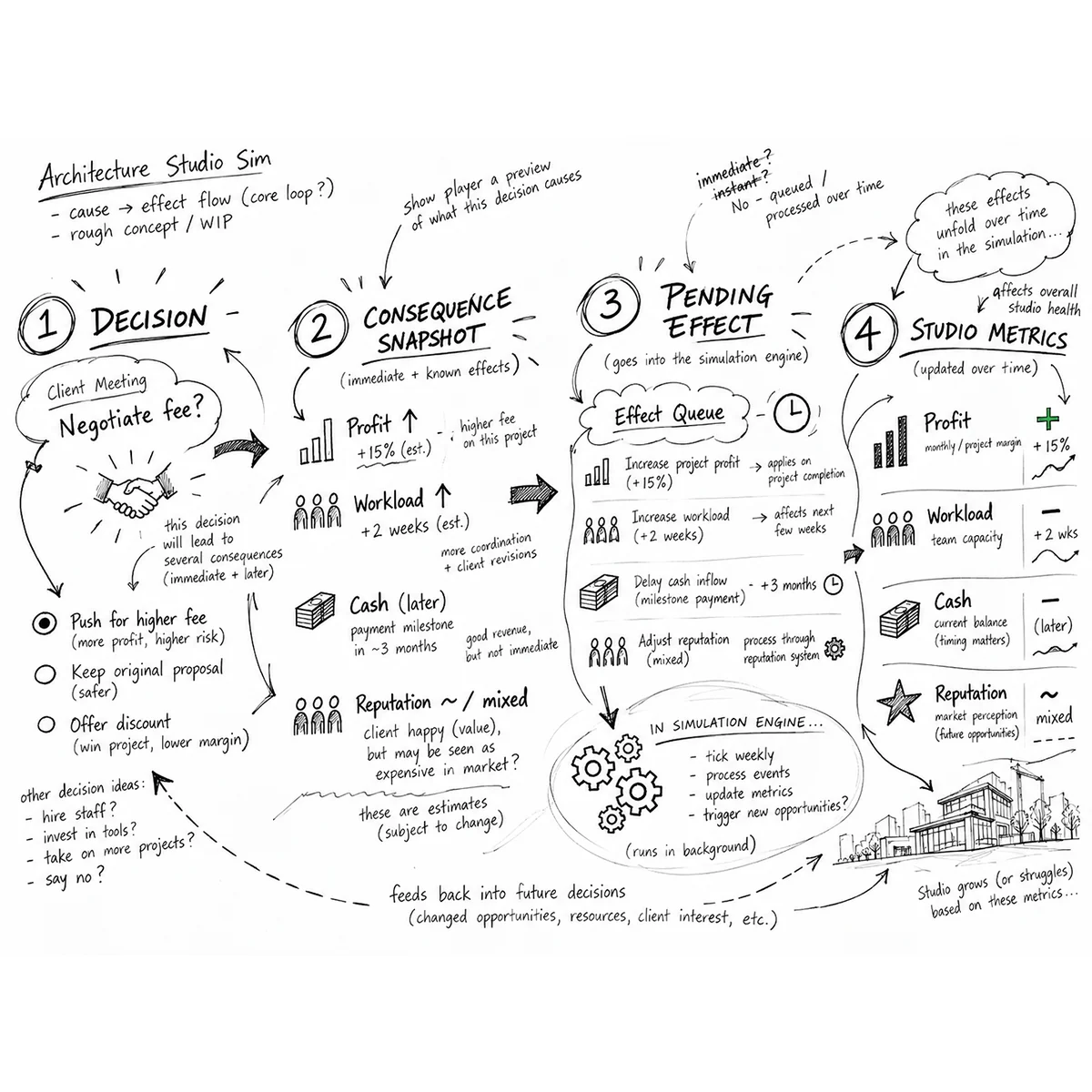
One decision changes more than one number
A business decision can affect several parts of an architecture studio. Profit, workload, cash and reputation each describe a different aspect of the practice. Looking at only one can leave important questions unanswered.
In Architect High Level, I am working on the path between a player's choice and its numerical consequences. The goal is straightforward: the consequence attached to the decision must be the consequence actually applied to the simulated studio.
That consistency matters before any discussion about winning strategies can become useful.
From a choice to a recorded effect
When a decision is committed, the engine captures a snapshot of its numerical consequence. This records the relevant values at the moment the choice becomes part of the game.
The consequence then travels through a Pending Effect before being reconciled with the Metric Ledger, the record used to track metric changes.
Those technical names describe a simple responsibility: carry the original numbers through the process without silently replacing them. A later step should not transform the consequence into something different from the one attached to the decision.
Why studio metrics need context
Imagine a fictional architecture practice considering another commission. The opportunity might look attractive when viewed through potential income, while also raising questions about capacity and delivery.
This example is a way to think about business tradeoffs, rather than a claim about a particular implemented scenario. It illustrates why architecture practice management involves several connected questions.
What happens to workload? What does the commitment mean for cash planning? How might delivery affect the studio's reputation? What assumptions support the expected project profitability?
A useful simulation should give players a coherent basis for exploring those questions. That requires both understandable metrics and dependable calculations behind them.
Reliable numbers support better questions
If the numbers change unexpectedly between the decision and its application, the player loses that basis. A result might appear to challenge their strategy when the real problem is a broken connection inside the game.
Preserving the numerical consequence helps separate business reflection from software inconsistency. The player can examine the choice and its recorded effect, rather than trying to explain an accidental change.
This does not make the simulation a prediction of real business results. It makes the simulated experience internally consistent, which is essential to the learning experience I am building.
Growth begins with understanding consequences
Architecture business growth is a useful theme for asking what a decision changes across the practice. More activity alone does not answer every question about resources, commitments or direction.
My current development priority is narrower and concrete: make sure the numerical effects attached to a decision reach the studio state correctly. Architect High Level remains in development, with this work supporting its intended business learning experience.
Explore Architect High Level and register for early access to follow ongoing progress on the game.
Built for architects running an architecture studio, interior design practice or landscape architecture studio, where the design business has to work too.