Business Decisions for Architects: Learning Through Realistic Game Situations
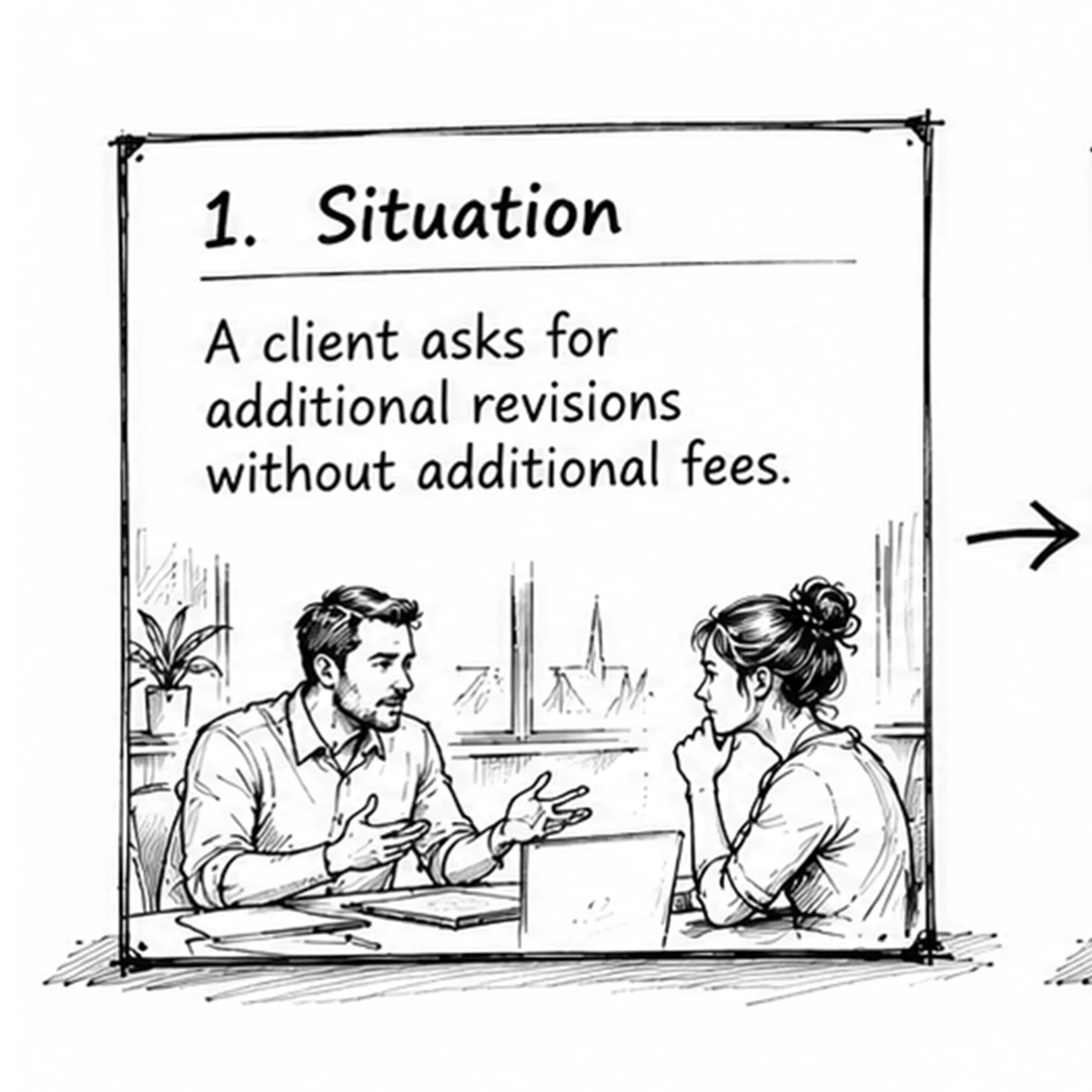
Hand-drawn card titled 1. Situation. The text reads: a client asks for additional revisions without additional fees. Two people sit at a desk with a laptop. 1 / 4
When a client asks for more
A client asks for additional revisions without offering additional fees. For an architecture studio, that request creates a business decision as well as a design task. Do you accept the extra work, discuss the scope, or propose another way forward?
That situation is one example from Architect High Level, the educational business game I am developing for architects and designers. Today I am testing its Situation Engine: the system that presents business situations and connects the player's response with what happens to the studio.
Three situations in every round
At this stage of development, the Core Game contains 34 different business situations. In each round, the player faces three and decides how the studio should respond.
The aim is to give creative people a clear framework for making business decisions. A situation introduces a problem, a decision gives the player a response, and the consequences reveal how that response affects the simulated practice.
This structure is central to the architecture simulation game I want to build. Instead of discussing studio management only in abstract terms, it puts a specific question in front of the player: what would you do next? Each response becomes part of the simulated studio's ongoing story.
Looking beyond the immediate request
Consider the revision example again. Agreeing immediately might feel like the easiest response. But before making that choice, there are other questions worth considering. How much work is involved? What was originally agreed? What other commitments need the same time?
These questions illustrate why scope management matters to the business side of design. A request that sounds small can still require a deliberate response. The useful learning opportunity is examining the choice and understanding what follows from it.
This example does not require a universal answer. Different circumstances can support different responses. What matters for the game is that the player can understand the situation, compare the available options and make an informed choice.
Testing a clear learning experience
My development focus is checking whether that sequence works coherently. Does the situation make sense? Are the choices understandable? Can the player connect the result with the response they selected?
For scenario-based learning, I want those connections to be visible. If the outcome feels unrelated to the decision, the experience loses its purpose. The Situation Engine therefore needs more than a collection of interesting problems: it needs a consistent relationship between situations, decisions and consequences.
An educational game for architects should make business thinking approachable while respecting the complexity of running a practice. That is the balance I am testing, one situation at a time.
Follow the development
Architect High Level is still being built. These tests are part of developing a business learning game around recognisable studio challenges and practical choices.
Explore Architect High Level and register for early access to follow the next stages of development.
Built for architects running an architecture studio, interior design practice or landscape architecture studio, where the design business has to work too.