Business Learning for Architects: Why Decisions Need Lasting Consequences
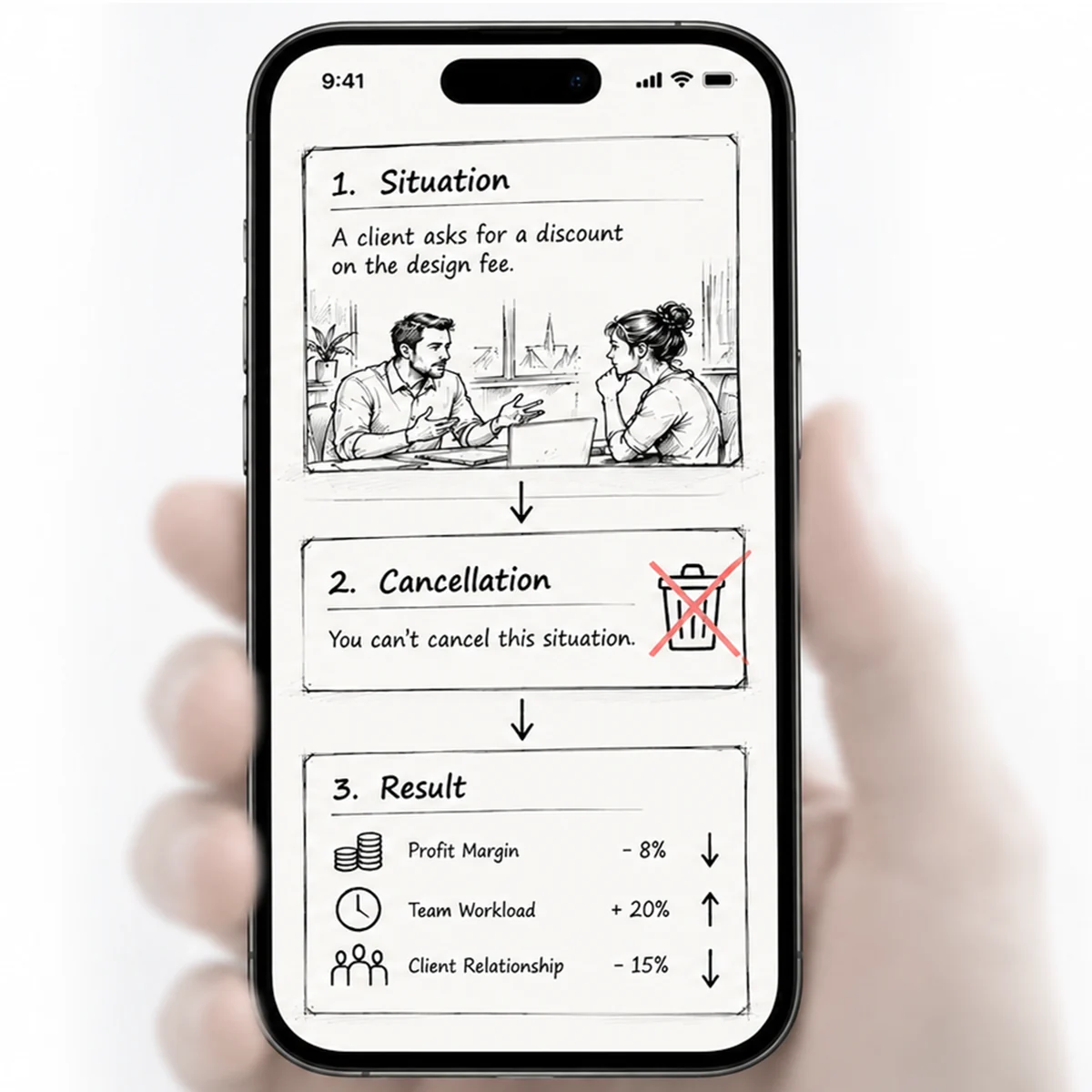
When a situation stays with you
An uncomfortable result is often the moment when a business decision becomes interesting. You chose a response, something changed, and now your architecture studio has to work with the outcome. Removing the situation simply because you dislike it would remove an opportunity to reflect.
That idea sits behind my current development work on Architect High Level, an educational business game for architects and designers. I am working on the rules that determine when a situation may be cancelled, and when it must remain active.
Cancellation needs a valid reason
The principle is straightforward: a situation can only be cancelled through an authorised game rule that has actually been committed. In everyday language, the game needs a valid, recorded reason for making that change.
If the engine cannot establish that reason, it should preserve the existing state. Old information or an incomplete instruction should never make an active situation disappear.
This does not mean that cancellation is impossible under every circumstance. It means that cancellation belongs to the game's defined rules. Disliking a consequence is not, by itself, permission to erase it.
Learning beyond the first choice
For an architecture practice, choosing a response is only part of business thinking. The next question is how to respond to what follows.
Consider a fictional studio that accepts additional work while its team is already stretched. The interesting discussion does not end with the initial agreement. What assumptions supported that choice? What needs attention now? What could the owner approach differently next time?
This is an illustrative business example, rather than a description of a specific implemented scenario. It shows the kind of reflection I want the simulation to encourage: looking at a decision, its consequences and the next available response within the simulated practice.
A consistent world for experimentation
An educational game offers a place to explore choices without placing a real client project at stake. Within that space, however, the rules still need to hold together.
If situations disappear unpredictably, players cannot tell whether their decisions mattered. If the same rules remain in force, they have a clearer basis for interpreting what happened.
My aim is to support business learning through that continuity. A difficult outcome should create a question worth examining, rather than become a technical inconsistency that distracts from the experience.
Building the foundation
Much of studio management concerns following through: reviewing commitments, recognising constraints and deciding what comes next. The game needs a dependable foundation before it can represent those questions convincingly.
Today's work focuses on that foundation. Every cancellation must have a valid source, and unproven changes must leave the existing situation intact. Architect High Level remains in development; these checks are part of making its decisions and consequences coherent.
Explore Architect High Level and register for early access to follow the development of this business simulation for architects.
Built for architects running an architecture studio, interior design practice or landscape architecture studio, where the design business has to work too.