A Business Simulation Game for Architects Who Want Better Project Returns
A full project schedule can look like success. But for an architect or designer, being busy does not automatically mean that your architecture studio is working well. The question is what remains after the work: income, available time, and enough capacity to make the next project worthwhile.
That is the starting point for Architect High Level. Our goal is to create a business simulation game for architects and designers who want to improve their return on investment but do not enjoy traditional business seminars. We want business decisions to become something you can explore through play.
Building an architecture business around better decisions
Consider a fictional studio choosing between two commissions. One offers a larger fee but requires extensive coordination and an uncertain number of revisions. The other is smaller, with clearer responsibilities and a more predictable workload. The bigger fee alone does not tell you which opportunity better serves the studio.
Understanding that choice means looking at the relationship between revenue, effort, and costs. It also means asking what accepting one project prevents you from doing elsewhere. These are the kinds of questions behind the game: how can business thinking become relevant to the decisions architects actually face?
Learning through decisions and consequences
The ambition is to give players space to make choices, examine the consequences, and reconsider their approach. A simulation can provide a setting for exploring business tradeoffs without putting a client relationship or a project budget at stake.
The goal is practical value. A useful experience should help you ask better questions about your own architecture practice. What makes a project worth taking? Where does the workload become difficult to sustain? Which numbers deserve attention before an apparently attractive commission turns into a demanding commitment?
Connecting studio management with project profitability
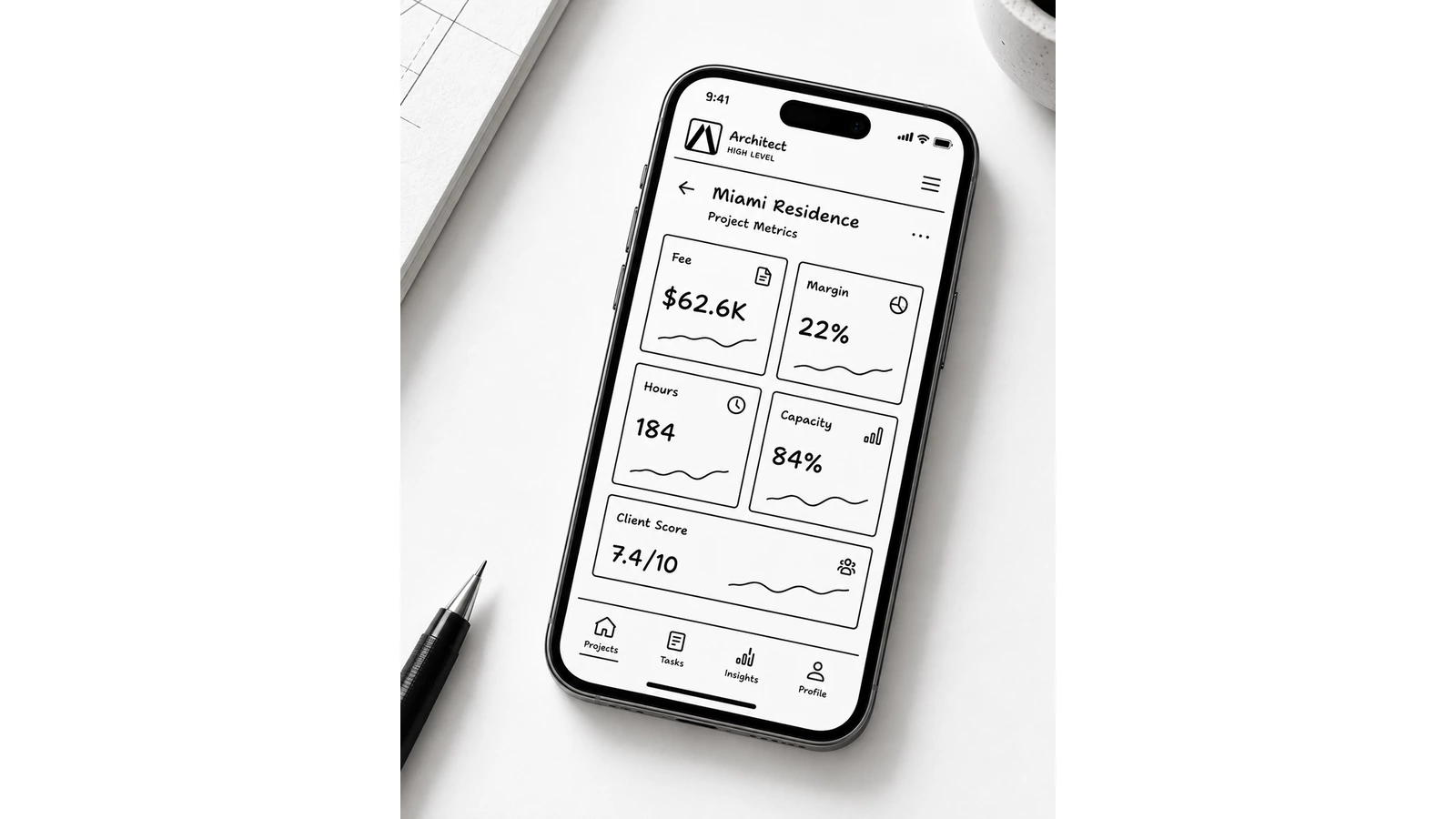
Metrics matter when they help explain a decision. A fee viewed alone tells a limited story. Read alongside hours, workload, and project margin, it can support a more useful discussion about the work a studio accepts and how that work is managed.
Our current development work focuses on Core Engine validation, Project Metrics, and repeated testing. That work reflects an essential priority: the underlying logic needs to be credible before the experience can deliver meaningful lessons. Attractive screens alone cannot establish whether the business relationships inside a simulation make sense.
Testing the foundation
Validation means checking whether the model behaves consistently and whether its results can be understood. For this project, that is part of building an experience where players can connect their choices with the outcomes they see.
We are developing toward that goal, rather than promising a guaranteed financial result. A game cannot account for every circumstance in an architectural practice. It can, however, be designed to make selected business questions easier to examine and discuss.
Explore the project and register for early access to follow the next stages of development.
Built for architects running an architecture studio, interior design practice or landscape architecture studio, where the design business has to work too.