Business Strategy Simulation for Architects: Learning from Completed Projects
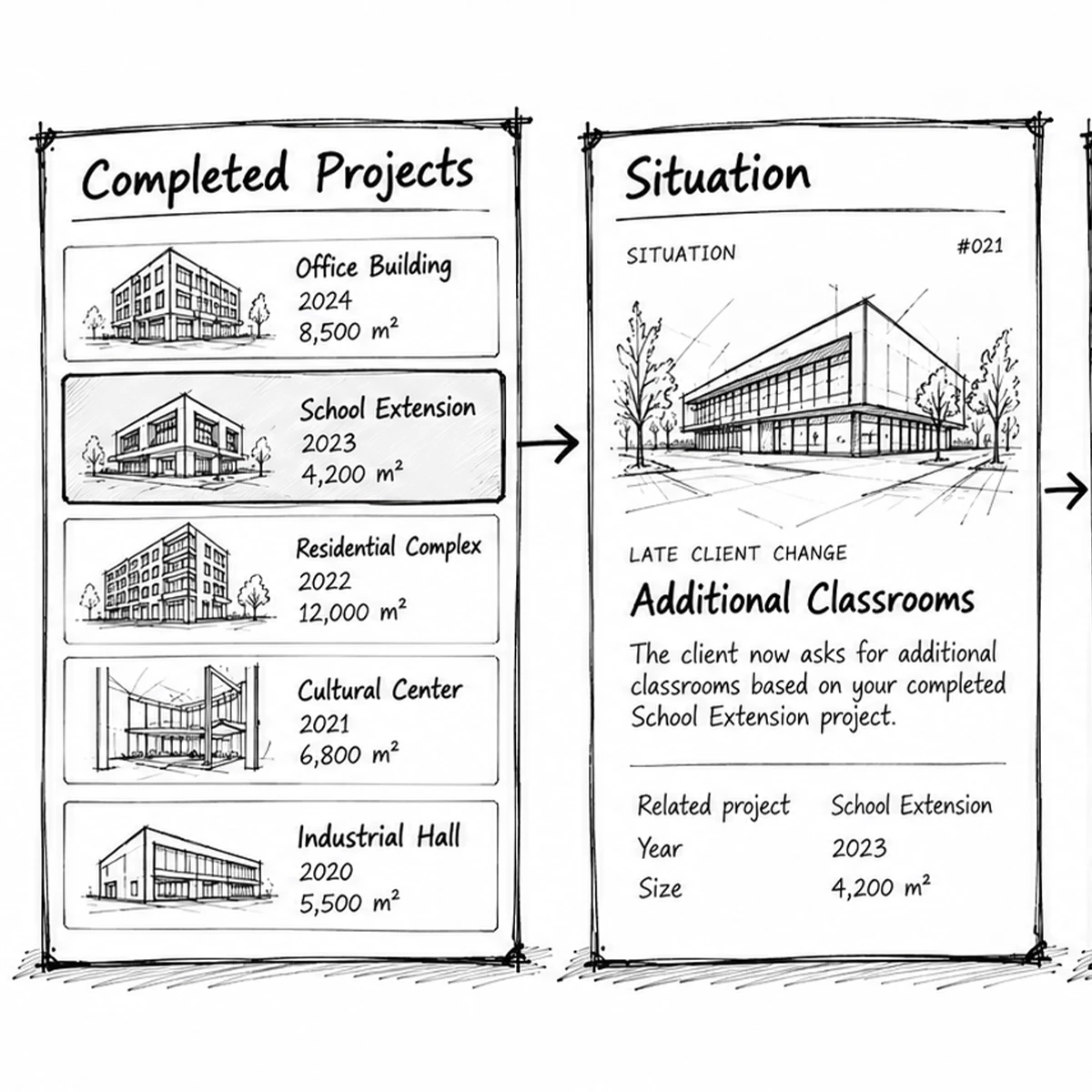
Hand-drawn diagram of completed projects. School Extension, 2023, 4,200 square metres, is selected and points to situation 021, Additional Classrooms, based on that project. 1 / 2
A finished project still has a history
Completing a project does not make it irrelevant to the story of an architecture studio. In Architect High Level, a new situation can now refer back to a project the player has already completed inside the game.
That is the focus of today's development work. It sounds like a small feature, but it supports a larger goal: helping architects practise business decisions and examine their consequences within a coherent simulation.
For that experience to work, the game needs to remember which project a situation concerns.
Why the right project matters
Imagine opening a situation linked to one completed project, saving your game and returning later. If the situation suddenly referred to another project, you could no longer interpret it with confidence.
Was the result connected to your earlier decision, or had the game changed the reference? That uncertainty would get in the way of learning.
The Situation Engine therefore has to find an eligible completed project, select it consistently and store that choice with the situation. When the player returns, the same project needs to remain attached. The context should remain recognisable throughout.
This is about completed projects in the player's simulated studio, rather than importing a portfolio of real client projects.
Reliable continuity supports useful reflection
The current work includes preserving the selected project through Save/Load and restoring it when the player re-enters the situation. The system also needs to reject an invalid project reference instead of accepting it silently.
Players should barely notice these checks when everything works. Their attention should stay on the business question in front of them.
Behind that simple experience is a development priority: the simulation must maintain a dependable history. Consistency gives the player a stable basis for asking why something happened and what an earlier choice contributed.
Connecting experience with studio strategy
Business strategy for architects involves looking at patterns across decisions, not only evaluating the next opportunity. A completed project provides context for reflection: what happened, what choices preceded it, and what questions should guide the next decision?
An architecture management simulation can create a setting for exploring those connections. The aim is to make past decisions part of an understandable business story, rather than leaving each situation disconnected from everything before it.
This also explains why I care about project history as a foundation for the learning experience.
Growth needs more than another project
For a design business, growth raises questions about how the studio works and which decisions it repeats. Looking back at completed work can help frame those questions before attention moves entirely to the next commission.
Architect High Level is being developed around that connection between decisions and consequences. Today's update is one technical step towards making the experience consistent enough to support meaningful exploration.
Explore Architect High Level and register for early access to follow its development.
Built for architects running an architecture studio, interior design practice or landscape architecture studio, where the design business has to work too.